
Wasp Nest Removal in Chesterfield: What I've Learned After Years of Doing This

Martin Gregory
I'm Gregg. I run Protecta Pest Control Ltd out of Chesterfield, and from late summer onwards my phone barely stops ringing about wasps.
Most people who call me are petrified. They've spotted a nest somewhere on the house, they haven't slept properly, and they want it gone. A few have had a go themselves first. Most haven't, because they know better than to get close to it.
This blog is the stuff I tell people at the door. No sales pitch. Just what I've actually seen on jobs across Chesterfield, Sheffield, Dronfield and the rest of Derbyshire.
Where I find most wasp nests
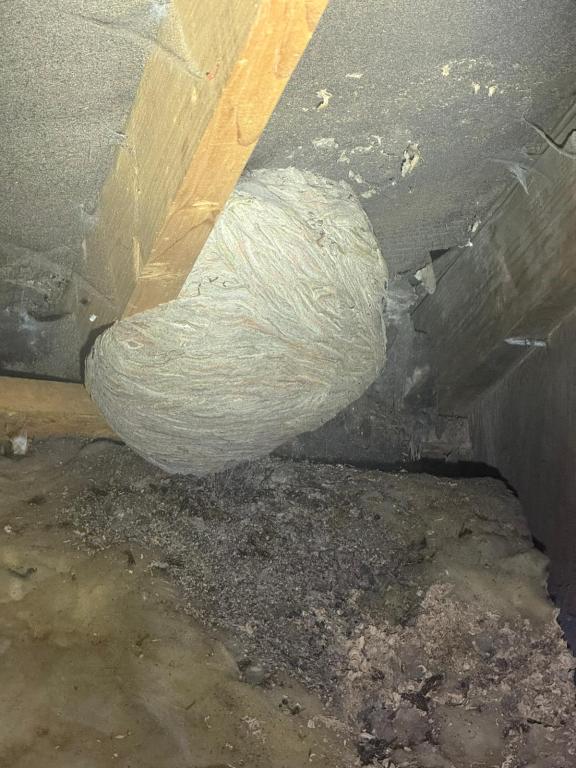
Nine times out of ten, the nest is in one of three places:
- Lofts. Pinned to a rafter near the eaves where the wasps have got in through a gap in the roof.
- Eaves and soffits. That gap between the top of the wall and the underside of the roof is a wasp magnet.
- Sheds. Especially old wooden ones. The corner of the roof, behind a shelf, inside an old plant pot left on the side.
Occasionally I find them in airbricks, log stores, decking, or buried in the garden. But lofts, eaves and sheds make up almost every call I get.
If you're hearing wasps but can't see a nest, watch the outside of the house for ten minutes. They'll be going in and out of one specific spot. That's your nest.
What people try before they call me
Honestly, most people don't try anything. They take one look at the nest, hear the noise, and ring me straight away. That's the right call.
The few who do have a go usually buy a shop spray and aim it at the nest entrance from a distance. Sometimes they get a few wasps. They never get the nest. The queen is sat right at the centre, protected by thousands of workers, and a shop-bought aerosol doesn't reach her.
Worse, the wasps now know they're under attack. They get defensive. The next person who walks past gets stung.
If you've already sprayed something and it hasn't worked, just tell me when I arrive. It doesn't change what I do, but it helps me know what to expect.
A wasp job I won't forget
Last year I got called to a bungalow. The nest was just above the bedroom window. Looked like a standard job from the ground.
I treated it, explained that all my work is guaranteed and I'll come back free if needed, and that was that. Or so I thought.
A week later the lady rang me back. The wasps weren't coming out of the same hole anymore. They were coming out of a different spot, about two feet across from where I'd treated.
A guarantee is a guarantee, so I went back the next day. She was right. New entry point. I asked if there was loft access and there was, so up I went. Head torch on. Opened the hatch.
It was a Jaws moment. "You're gonna need a bigger boat."
I turned my torch off straight away and quietly shut the hatch.
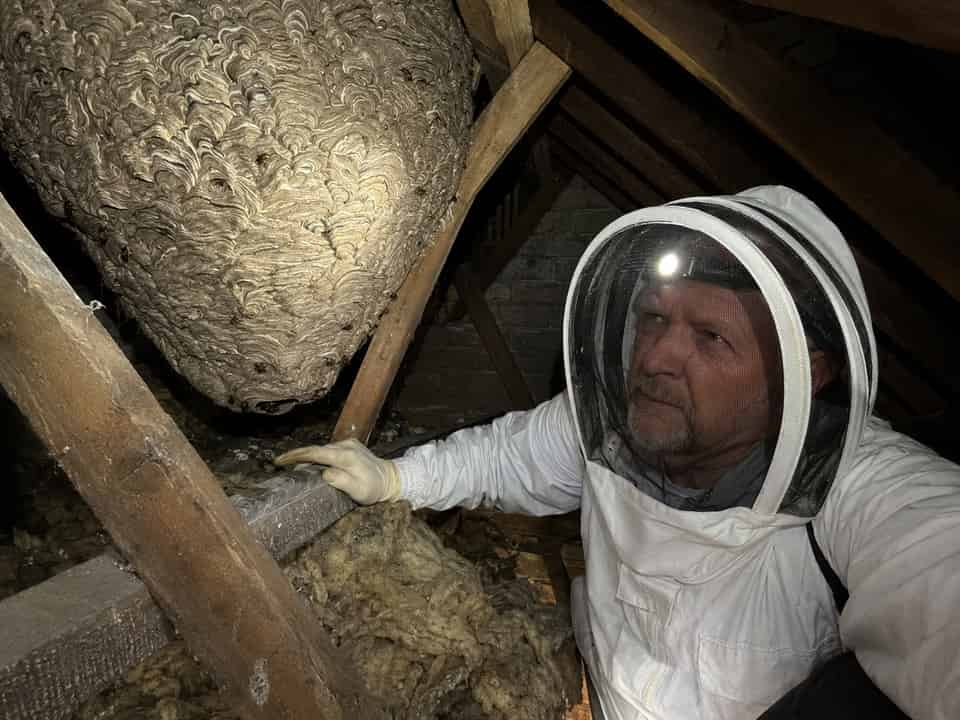
That nest was the biggest I'd ever seen. No word of a lie, if you laid a living room door flat against the roof beams, that's the size we're talking. Absolutely massive. Made my bum twitch, I won't pretend it didn't.
I tell that story because it's a good reminder. Wasp nests aren't always what they look like from outside. What seems like a small bit of activity at a hole can be a colony of thousands sat behind the plasterboard. That's why poking at one yourself is a bad idea.

What most people get wrong about wasps
Two things come up a lot.
"Wasps don't pollinate." They do. Not as much as bees, but they absolutely do. Adult wasps drink nectar and move pollen around while they're at it.
"Wasps are useless." They're a gardener's best mate. A single wasp colony eats thousands of aphids, caterpillars and other pests over a summer. If you grow veg or have a nice garden, wasps have been quietly helping you all year without you knowing.
I still treat the nest if it's near your house. Stings are stings, and a nest above a doorway is a real problem. But I won't pretend wasps are pointless, because they're not.
When the calls really pick up
Late summer. Every year, without fail.
By August and September the nests have been growing for months. They're at their biggest, the wasps are at their grumpiest, and the colony's diet has shifted from caterpillars to sugar. That's why they suddenly want your pint and your jam sandwich.
It's also when they get into the house. A few warm days, an open window, and you've got wasps in the kitchen.
If you spot a small nest in spring or early summer, that's actually the easy job. Smaller colony, fewer wasps, quick treatment. Leave it until August and it's a bigger nest with a much angrier crowd inside.
What I wish people knew
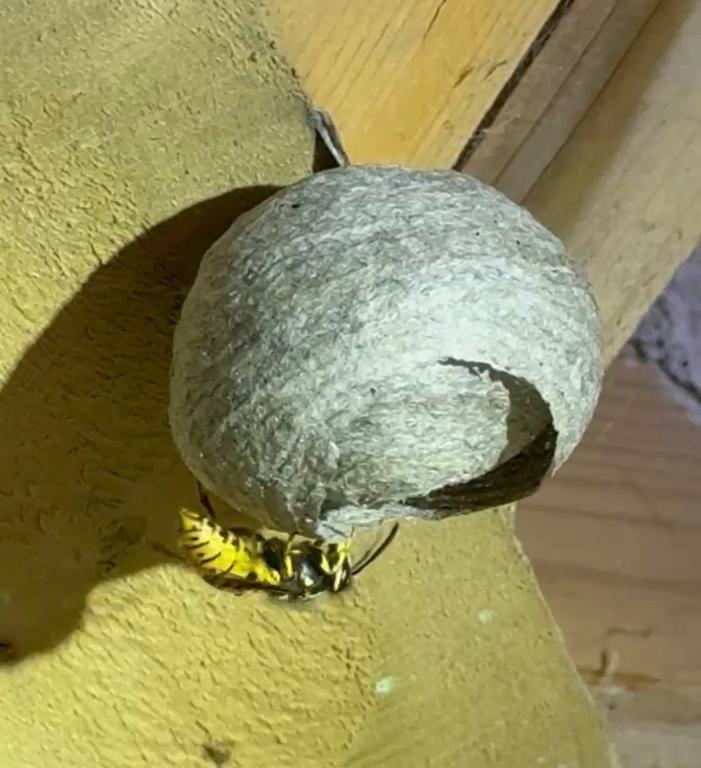
If you can catch a nest early, it's a straightforward job.
A small grey papery ball the size of a golf ball in April or May? Easy. Quick treatment, low risk, sometimes I'm in and out in fifteen minutes.
The same nest left until August is now a football, full of thousands of wasps, and the moment something disturbs it they're out looking for whatever moved.
So if you see a small nest forming, don't wait. Don't think "I'll deal with it later." Later is when people get stung.
Next steps
If you've found a wasp nest at your property in Chesterfield, Sheffield, Dronfield or anywhere across Derbyshire, give me a ring.
Pricing is simple:
- Standard wasp nest treatment: £60
- Any second nest at the same property treated at the same visit: £25
- No call-out fee
- All work guaranteed. If anything comes back, I come back free.
While you're waiting:
- Keep windows and doors closed on the side of the house the nest is on.
- Keep kids and pets away from the entry point.
- Don't spray it, hit it, or block the hole.
- If it's in the loft, leave the hatch shut.
That's it. Have a brew, and I'll be there as soon as I can.
Get in touch:
Gregg, Protecta Pest Control Ltd Call Norma to book: 07398 674924 Hours: Monday to Friday, 24 hours. Weekends by arrangement. Covering: Chesterfield, Sheffield, Dronfield, and the wider Derbyshire and South Yorkshire area.